

Dorcy Luminator 6v Floating Lantern How To Install Battery
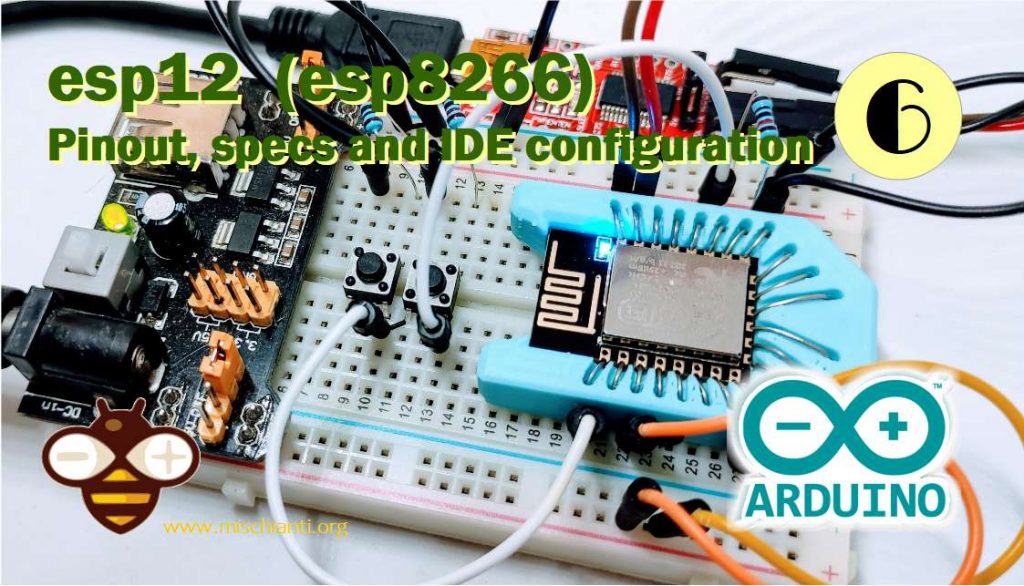
Hither another article near esp8266, at present we are going to introduce the single module, Information technology tin be used without integrated developer board, simply to program we must do some wiring and get an adapter.
esp-12 and esp-07
esp-12 esp-07 Aliexpress esp-12 - Aliexpress esp-07
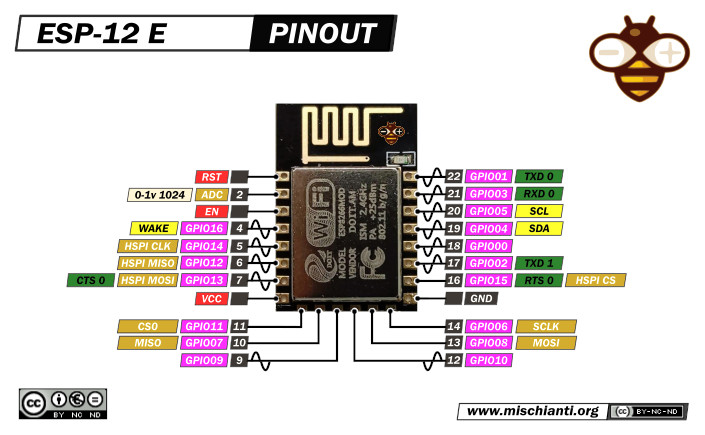
esp12 E pinout hight resolution
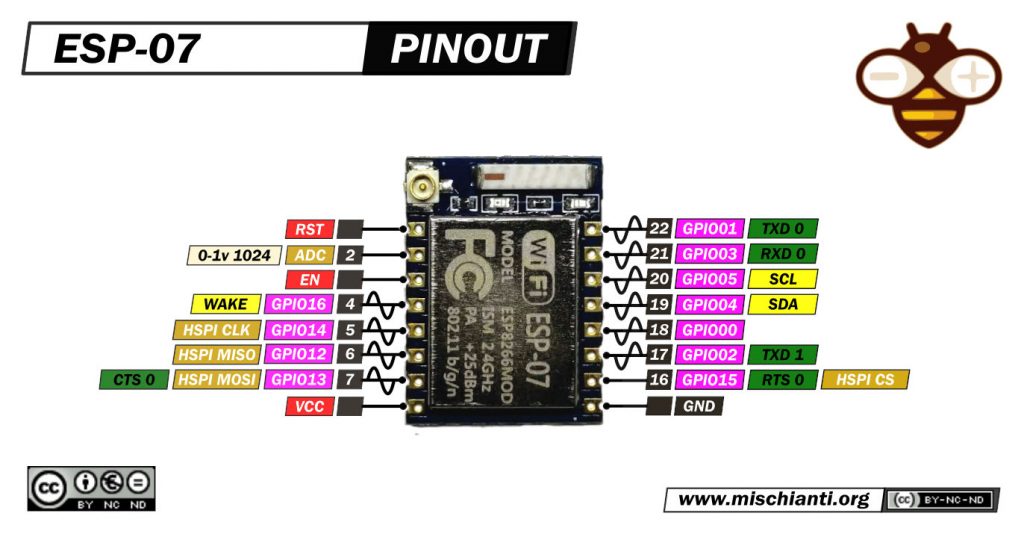
esp07 pinout hight resolution
Specs
- CPU and Memory
- Processor: L106 32-bit RISC microprocessor core based on the Tensilica Xtensa Diamond Standard 106Micro running at 80 MHz
- RAM size < 36kB, that is to say, when ESP8266EX is working nether the station mode and is connected to the router, programmable space accessible to user in heap and data section is around 36kB.)
- External SPI Flash: mounted with an 4 MB external SPI for esp12 and 1Mb for esp07 flash to store user programs.
- the frequency of crystal oscillators supported include 40MHz, 26MHz and 24MHz.
- UART Back up 300 ~ 4608000 bps ˈDefault 115200 bps
- Package SMD16 for esp07 and SMD22 for esp12
- Wi-Fi
- 802.eleven b/chiliad/north
- Integrated TCP/IP protocol stack
- Integrated TR switch, balun, LNA, power amplifier and matching network
- Integrated PLL, regulators, and power management units
- Supports antenna diversity
- Wi-Fi ii.4 GHz, support WPA/WPA2
- Support STA/AP/STA+AP operation modes
- +20dBm output power in 802.11b mode
- Wake upwardly and transmit packets in < 2ms
- Back up Smart Link Function for both Android and iOS devices
- Advanced Peripheral Interfaces
- Integrated ten-bit ADC
- SDIO 2.0, (H) SPI, UART, I2C, I2S, IRDA, PWM, GPIO
- STBC, ane×1 MIMO, 2×1 MIMO
- A-MPDU & A-MSDU aggregation and 0.4s guard interval
- Deep sleep power <10uA, Power down leakage electric current < 5uA
- Standby ability consumption of < 1.0mW (DTIM3)
- Operating temperature range -40C ~ 125C
3D printed adapter
A adept and fast solution is to print one adapeter. Exists a lot of adapter, but I think this is a good choice.
Socket for esp12 and esp07
Socket for esp12 and esp07 with V base
Wiring
There are some connexion to practice to correctly use the board, first we must power and pull upward and pull down some pins.
Normal start
With this configuration you enable the unmarried-thespian (PULL-Upwardly EN), and the reset is prevented and a low GPIO0 or FLASH is prevented to prevent enisci in programming mode.

- EN, RST and GPIO0 needs to be pulled high using a 10K resistor;
- GPIO fifteen needs to be pulled downwardly using a 10K resistor;
- then we must power the lath with three.3v and more 200mA of stable electric current.

Enter wink mode
Now to put in programming mode you must add 2 button, one to reset the device (put to ground RST), and one to send Low betoken to GPIO0.
And then pull upwardly RST and GPIO0 with resistor, and attach a push button that put the pin to Basis like the schema.
To enter boot manner you must:
- Hold down the Flash push;
- Printing and release the RST button;
- Release FLASH button.

Programming with FTDI (USB to Serial converter)
To program the device it is necessary to utilise a FTDI converter, there are various types, some that transmit and receive only, and others that also provide a supply voltage (selectable).
Here some model of FTDI AliExpress USB to TTL CH340G - AliExpress USB to TTL FT232RL
At present y'all must share Basis pin, and put RX of FTDI to TX of esp and TX to RX.

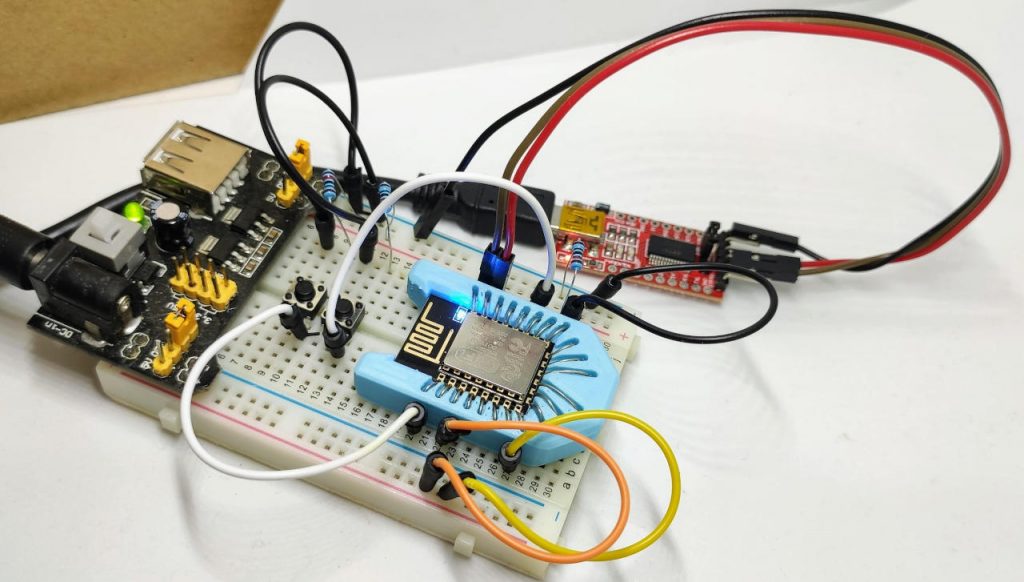
Here the breadboard result.
| Mode | GPIO15 | GPIO0 | GPIO2 |
|---|---|---|---|
| UART | Low | Low | High |
| Flash Kick | Low | High | High |
Configure IDE
esp12
In the Arduino IDE you must install esp8266 surroundings, refer to "WeMos D1 mini (esp8266), pinout, specs and IDE configuration", so you need to configure the settings on the card, for ESP12 you need to set up:
- Board: NodeMCU one.0 (ESP-12E Module)
- Builtin Led: 2
- Upload Speed: 921600 (115200 is more secure)
- CPU Frequency: 80 MHz
- Wink Size: 4MB

esp07
For the esp07 I'm going to use this settings
- Lath: Generic esp8266 Module
- Builtin Led: 2
- Upload Speed: 921600 (115200 is more secure)
- CPU Frequency: 80 MHz
- Crystal Frequency: 26 MHz
- Reset Method: dtr
- Wink Size: 1MB

Upload a simple glimmer sketch
At present you must only:
- Hold down the Flash button;
- Press and release the RST button;
- Release Flash push;
- Offset the upload of this sketch;
// the setup function runs once when yous press reset or power the board void setup() { Serial.brainstorm(115200); // initialize digital pin LED_BUILTIN every bit an output. pinMode(LED_BUILTIN, OUTPUT); } // the loop function runs over and over again forever void loop() { digitalWrite(LED_BUILTIN, Loftier); // plough the LED on (Loftier is the voltage level) Series.println("HIGH"); delay(k); // expect for a 2nd digitalWrite(LED_BUILTIN, Low); // turn the LED off by making the voltage LOW Serial.println("Depression"); delay(k); // await for a 2nd } - connect serial monitor with 115200 baud rate.
Here the panel log
Connect to serial port COM18 at 115200 Low High Low Loftier Depression High Depression HIGH Low High Programming board PCB
I also share the programming lath PCB, I'm going to practice an commodity on Information technology.

esp-12 esp-07 (esp8266) programming board and breadboard adapter
Thank you
- WeMos D1 mini (esp8266), specs and IDE configuration
- WeMos D1 mini (esp8266), integrated SPIFFS Filesystem
- WeMos D1 mini (esp8266), debug on secondary UART
- WeMos D1 mini (esp8266), the iii type of sleep mode to manage energy savings
- WeMos D1 mini (esp8266), integrated LittleFS Filesystem
- esp12 esp07 (esp8266): flash, pinout, specs and IDE configuration
- […]

Source: https://www.mischianti.org/2021/05/08/esp12-esp07-esp8266-flash-pinout-specs-and-arduino-ide-configuration-6/
Posted by: willheddleggliha.blogspot.com
0 Response to "Dorcy Luminator 6v Floating Lantern How To Install Battery"
Post a Comment