

The Asus ProArt Studiobook reinvents the wheel for content creators - willheddleggliha
Asus's new ProArt Studiobook and Studiobook Pro series just reinvented the pedal. These laptops literally sport an embedded bicycle embedded for content creators who need to quickly scour through media or make quick adjustments.
You might not even looking down at that wheel though, because it might be hard to rip your eyes away from the 16-inch, 4K+, 16:10 "third-generation" OLED screen Asus uses in the StudioBook series.
OLEDs undergo long suffered from burn up-in concerns, but Asus says the a la mode Samsung technology helps mitigate that peril. The OLED features pixel-story wear down levelling that monitors from each one subpixel's use, and information technology wish occasionally shift pixels slimly as well.
Asus aforementioned it also includes a concealment saver on the far side the one stacked into Windows. It will switch on mechanically, dimming the sort after five minutes. Both features can be turned soured but the Studiobook will cough up warning messages of the potential consequences.
 Asus
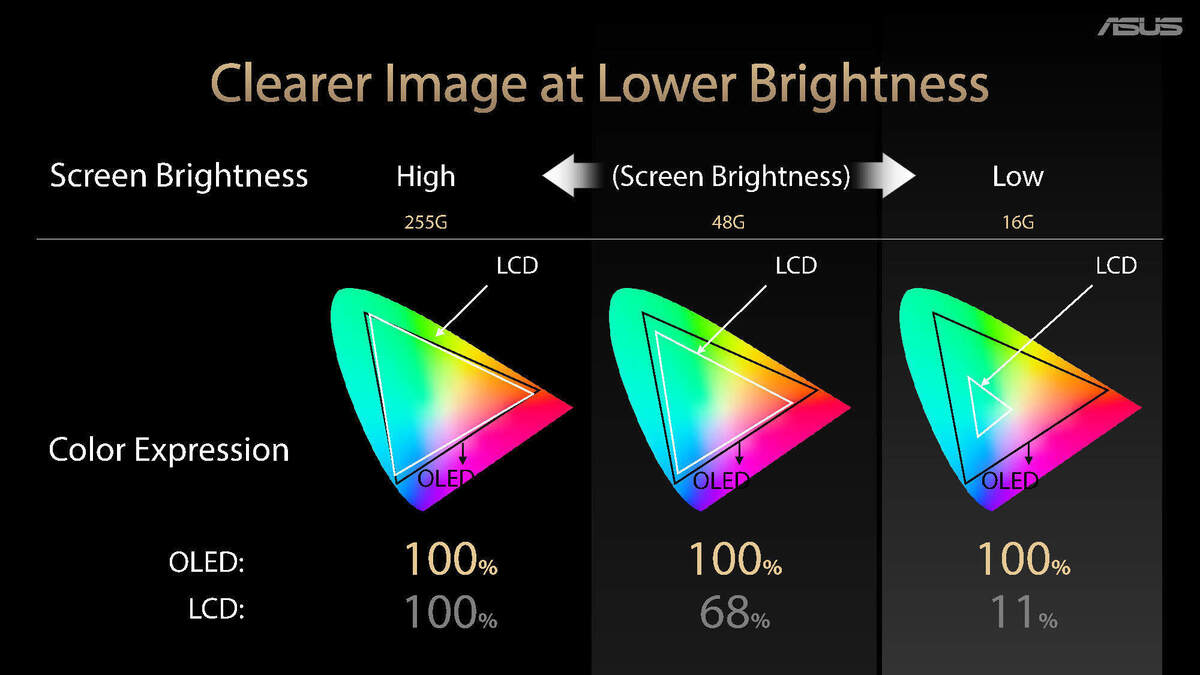
Asus An OLED much as the ones in the new ProArt StudioBook's offer superior colourise gamut at lower brightness levels than IPS panels.
The factory-graduated panels offer 100 percent of the DCI-P3 color space, can hit a dazzling 600 nits, and feature 0.2 ms old-to-grey response. That's about 100 times faster than typical screens, the company said.
Another attribute of the OLEDs that may be attractive to content creators is the color gamut, Asus said—even at let down brightness settings where tralatitious IPS panels lean to digest. That can also understand to amend battery life in few respects, since your eyes perceive the banner dividing line of an OLED arsenic being brighter than a comparable IPS panel. That way you can extend to the dialog box at a lower brightness setting, but your eyes will think its as bright as a typical IPS panel.
Dialing it in
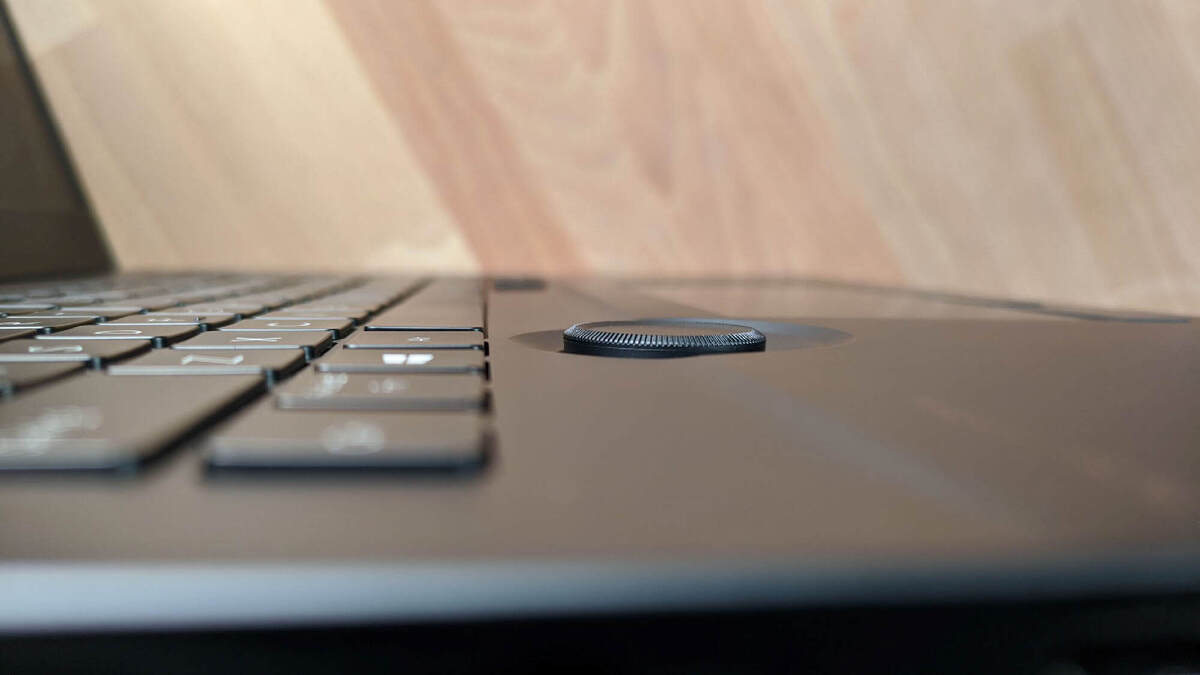
Indeed yes, the Studiobook laptops pack a beautiful awesome panel, but the feature Asus hopes will appeal more to contentedness creators is the Asus Dial. The Asus Dial is a bodily ramble telephone dial and button in one that lets you scrub finished the timeline in an Adobe Premiere video. It's like a telecasting-centric spin on Microsoft's art-focused Studio Dial.
Asus and Adobe worked together to integrate support for the Asus Dial in Photoshop, Lightroom Classic, Aft Effects, and others apps in the retinue.
 Asus
Asus The Asus telephone dial is a physical dial with support from Adobe applications. And don't vex, information technology's actually the same level as the keyboard so it won't scratch the blind.
Asus said laptops with spearhead-shaped ii-release trackpads aren't enough for professionals who typically have an additional key to use with workstation apps, so information technology also added a third-clit to the raceway pad.
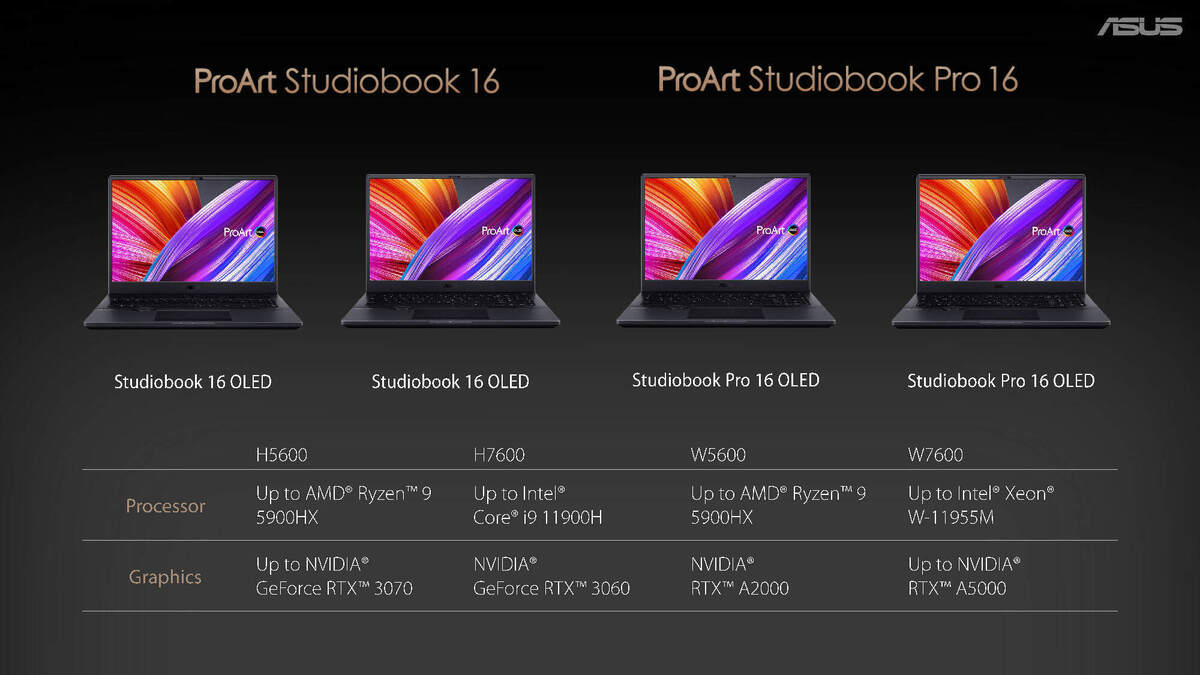
None of this would mean anything without good hardware under the hood. Along that tip, Asus doesn't force you pick between AMD and Intel. Itt offers the ProArt Studiobook 16 H5600 OLED and ProArt Studiobook Pro 16 OLED W5600 with adequate to an AMD Ryzen 9 5900HX. If Intel's 11th-gen Panthera tigris Lake H fits your easygoing creation needs better, you can get the ProArt Studiobook 16 H7600 OLED and ProArt Studiobook Professional 16 OLED W7600, with options ranging up to the 11th-gen Core i9-11900H.
What's the dispute between the Pro and not-Pro versions of the ProArt Studiobook? The GPU. The AMD-based H5600 comes with skyward to a GeForce RTX 3070 Laptop GPU and the Intel-based H7600 comes with up to a GeForce RTX 3060. While those are great GPUs for content creators, they aren't really "Pro," that's where the Studiobook Pro stands out. The AMD-based Affirmative W5600 will see up to a Ryzen 9 5900HX mated with an Nvidia RTX A2000, while the Intel-supported Pro W7600 leave swap the Core i9 for a Xeon W-11955M paired with an RTX A5000.
Those workstation graphics cards each feature Nvidia's GA104 GPUs, with the A5000 featuring a CUDA core count similar to a GeForce RTX 3080, and the A2000 someplace between a GeForce RTX 3060 and GeForce RTX 3070.
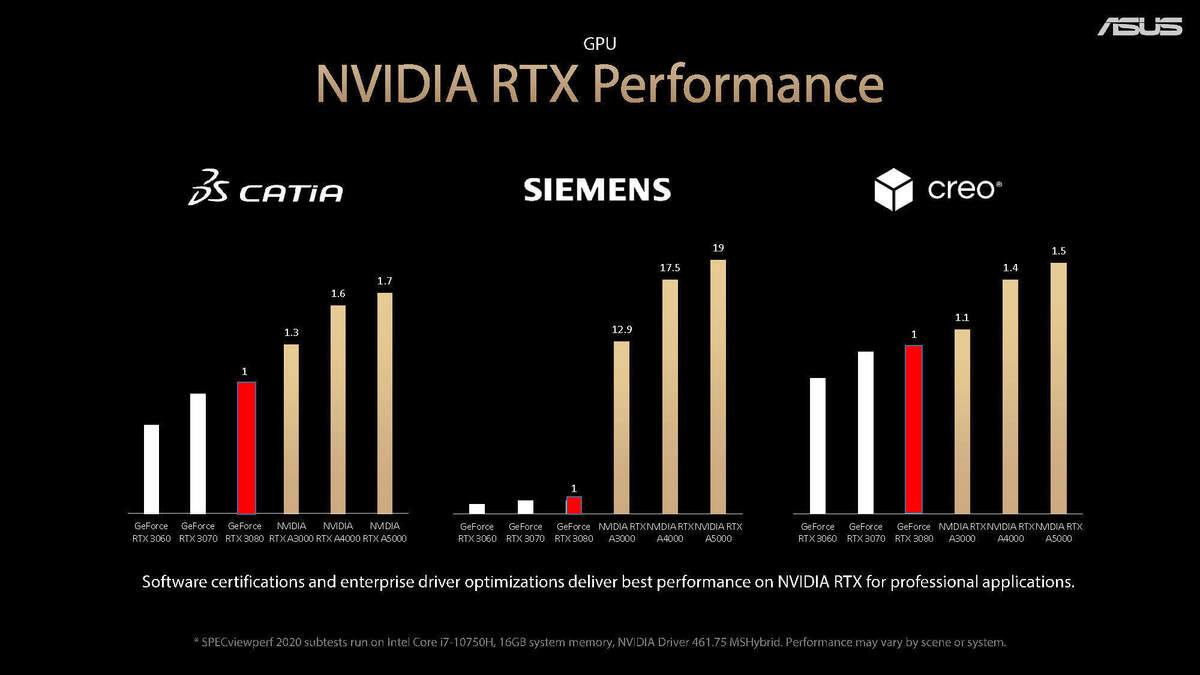
Some A-series Pro GPUs also get certifiable drivers for consumption with professional workstation applications, which fanny significantly step-up performance in some cases. Yes, that's typically an artificial partition raise by Nvidia, but for person doing it for a living, it's worth the fine. If you habit Catia, Mho or Creo, then you'll want to arrive at for a Pro RTX GPU instead.
 Asus
Asus Definite professional applications get a advance from certified number one wood support.
Keeping modern hardware caller is the describe to up performance. Asus said its IceCool Pro thermal solution offers adequate to 110 watts of TDP while keeping the noise below 40 dBA, or upwardly to 140 watts of cooling under 50 dBA.
Price and availability
The Asus ProArt Studiobook Pro 16 OLED W5600 and W7600 will be available in the next three months with a price starting at $2,500. The AMD-supported ProArt StudioBook 16 OLED H5600 and the Intel-based ProArt StudioBook 16 OLED H7600 will also glucinium on tap by the end of the year with a price opening at $2,000.
 Asus
Asus 
Source: https://www.pcworld.com/article/395097/the-asus-proart-studiobook-reinvents-the-wheel-for-content-creators.html
Posted by: willheddleggliha.blogspot.com
0 Response to "The Asus ProArt Studiobook reinvents the wheel for content creators - willheddleggliha"
Post a Comment